Canada Pension Plan (CPP/QPP)
This article reviews the default settings for the Canadian Pension Plan (CPP) or Quebec Pension Plan (QPP) benefits in your projections and how to make modifications.
NOTES:
- Default CPP/QPP Amount: Snap assumes your clients will receive the national average CPP/QPP benefits (currently 59.20%) as of the current year and indexed with inflation; however, this may not be the case for your particular scenario. You can adjust the percentage of the maximum benefit as shown below. This value is updated in Snap annually (and not quarterly) with the information available at year-end.
In this article:
- 1
-
Accessing the Gov't Benefits page
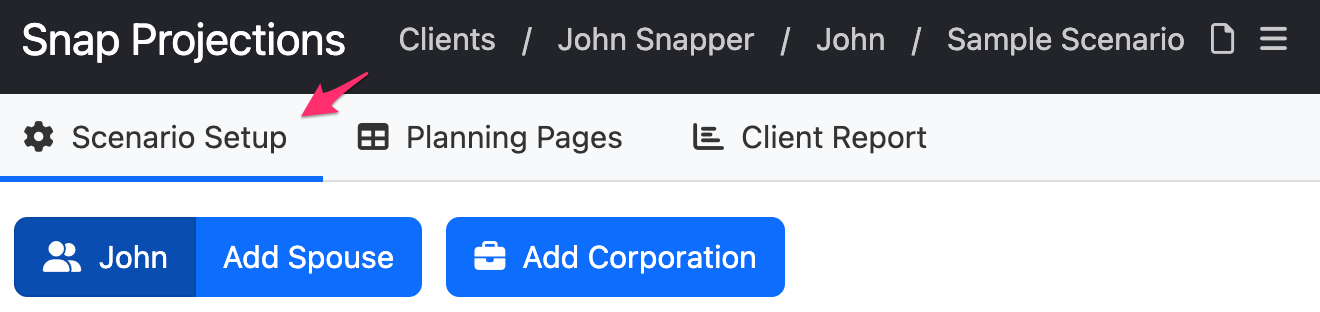
Select Scenario Setup -> Gov’t Benefits to view the CPP or QPP information for the individual. For the examples in this article, we will refer to CPP but note that for clients residing in Quebec you will see QPP instead of CPP on the Gov't Benefits page.
- 2
-
Modify the Percent of Maximum (at age 65)
The Percent of Maximum (at age 65) indicates the percent of the future maximum benefit (base and enhanced) in the year that the client turns 65 that you expect them to receive. The CPP/QPP enhancements that started in 2019 will increase the maximum CPP/QPP retirement pension by up to 50% for those who make enhanced contributions for 40 years. If you enter a percent of maximum (at age 65) of 100%, it means you expect the client will receive both the maximum base amount being paid today, and the maximum enhanced payments that they'd be eligible for based on their year of retirement.
As a default, the software provides each client and spouse with the national average for CPP/QPP. You can then adjust the Percentage of Maximum (at age 65) manually if the individual is expected to receive a different amount. Type in a new percentage and move the cursor away from this field with your mouse, or press the Tab key. The Annual Retirement Pension will adjust automatically.

In the above example, we've entered 80%, which increased the expected Annual Retirement Pension. There's also language that outlines the difference between your entered percentage and the national average. In this case, the 80% entered is 24 percentage points higher than the national average.
- 3
-
CPP/QPP Start Age
The standard age to start the pension is 65, but you can choose to start it as early as age 60 or delay it as late as age 70. If the CPP/QPP start age is below 65, the client will receive a reduced CPP/QPP benefit and if it is above 65, the client will receive an increased CPP/QPP benefit. By adjusting the start age, the CPP/QPP amount will be automatically updated in the Annual Retirement Pension box. The Percent of Maximum (at age 65) may need to be manually adjusted based on the individual's enhanced CPP/QPP entitlement, as shown below.
In Snap, the CPP/QPP start age defaults to the retirement age of the individual as indicated in the initial data entry for the projections. If the individual's retirement age is before age 60, CPP/QPP will start at age 60 and if the retirement age is after age 70, CPP/QPP will start at age 70. You can modify the CPP/QPP Start Age.
Option 1: Start CPP/QPP early
Enter an age lower than 65, in which case the client will receive a smaller CPP/QPP benefit. Here is an example of reducing the CPP/QPP start age to 60. The pension amount will be automatically updated in the Annual Retirement Pension box and the Percent of Maximum (at age 60) will also be updated.

When the Start Age is changed to an earlier age, the Percentage of Maximum (at age 65) is assumed to remain constant, and the Annual Retirement Pension is calculated using the new start year and the projected maximum CPP/QPP Benefit at that time. This is a conservative assumption because we don't have the historical contribution data to calculate their expected benefit automatically. You can adjust the Annual Retirement Pension or Percentage of Maximum (at age 65) after changing the Start Age if appropriate.
Option 2: Delay CPP/QPP
Enter an age greater than 65 and the received benefit will be larger. In this example, we start CPP/QPP at age 68. The pension amount will be automatically updated in the Annual Retirement Pension box, the Percentage of Maximum (at age 65) will be updated to 77.26%, and the Percent of Maximum (at age 68) will also be updated to 96.73%.

When the Start Age is changed to a later age, the Annual Retirement Pension is recalculated by removing any early penalty that was being applied (a reduction of 7.2% per year before age 65) and by adding any deferral benefit that they would receive (an annual increase of 8.4% per year after age 65). The Percentage of Maximum (at age 65) is calculated using the new start year and the projected maximum CPP/QPP Benefit at that time. This is a conservative assumption because we don't have the historical contribution data to calculate their expected benefit automatically. You can adjust the Annual Retirement Pension or Percentage of Maximum (at age 65) after changing the Start Age if appropriate.
- 4
-
Enter the known Annual Retirement Pension
If you know exactly how much your client receives in CPP/QPP benefits today, a useful option is to simply enter this amount. The Percentage of Maximum fields will be automatically updated. This Annual Retirement Pension amount will be displayed on the Planning page in the year that the client is the same age as the CPP/QPP Start Age or in the first year of the projections if their current age exceeds the CPP/QPP Start Age.

- 5
-
Indexing Rate for CPP/QPP
To index the CPP/QPP values for all years, you can specify the desired percentage in the Indexing Rate for CPP/QPP text box at the bottom. Note that the Annual Retirement Pension amount will be indexed at this indexing rate until the year that the CPP/QPP benefit is received and going forward. The default indexing rate for CPP/QPP is the same as the inflation rate (See Scenario Setup -> General).

- 6
-
Prorate the first year of CPP/QPP
To provide a partial year's benefit for CPP/QPP in the first year that it is received, please make sure the checkbox Prorate first year of CPP/QPP is checked. The first payment will be issued in the month following the client's birth month.

- 7
-
Illustrate Survivor's Pension
By default, Snap will illustrate a survivor's CPP/QPP pension. In the surviving spouse's projections, you will see a new column for CPP/QPP Survivor's Pension. The amount received is based on the deceased spouse's CPP/QPP pension and the survivor's age. You may uncheck this box to disable this feature for a scenario.


We have implemented paragraph 58(2) of the Canada Pension Plan Act, which in some cases reduces the amount of CPP/QPP survivor’s pension. If you are interested in reading more about the CPP/QPP survivor's pension, you may find this blog post helpful from retirehappy.ca.
- 8
-
Enhanced CPP/QPP
Your projections take into account the Enhanced CPP contributions and benefits based on Bill C-26. Contributions are automatically adjusted to the contribution rates and earnings ceilings. CPP and QPP benefits automatically include the enhancement based on the number of years your client is eligible to make higher contributions to the CPP/QPP. For clients residing in Quebec, enhancements to QPP are followed.
(Between 2019 and 2023, contribution rates for employees increased from 4.95% to 5.95% (5.4% to 6.4% for QPP). From 2024 onwards, a second ceiling of Yearly Maximum Pensionable Earnings (YMPE) is added that is 14% higher than the first ceiling. The contribution rate on this second ceiling (also known as the Yearly Additional Maximum Pensionable Earnings, YAMPE) is 4% for employees. )
- 9
-
CPP/QPP Sharing
CPP/QPP Sharing is not the same as pension income splitting and is therefore not included in the automatic pension income splitting calculations in Snap Projections. CPP/QPP sharing has to be applied for and is done at source if approved.
To reflect CPP/QPP sharing in Snap, the best approach is to update each spouse's CPP/QPP benefit amount under Scenario Setup -> Gov't Benefits. The combined total of the 2 pensions must stay the same whether the couple is sharing their pensions or not.